
When a Thought Becomes a Fire: Lessons from the Brothers of Yusuf (AS)
Apr 04, 2026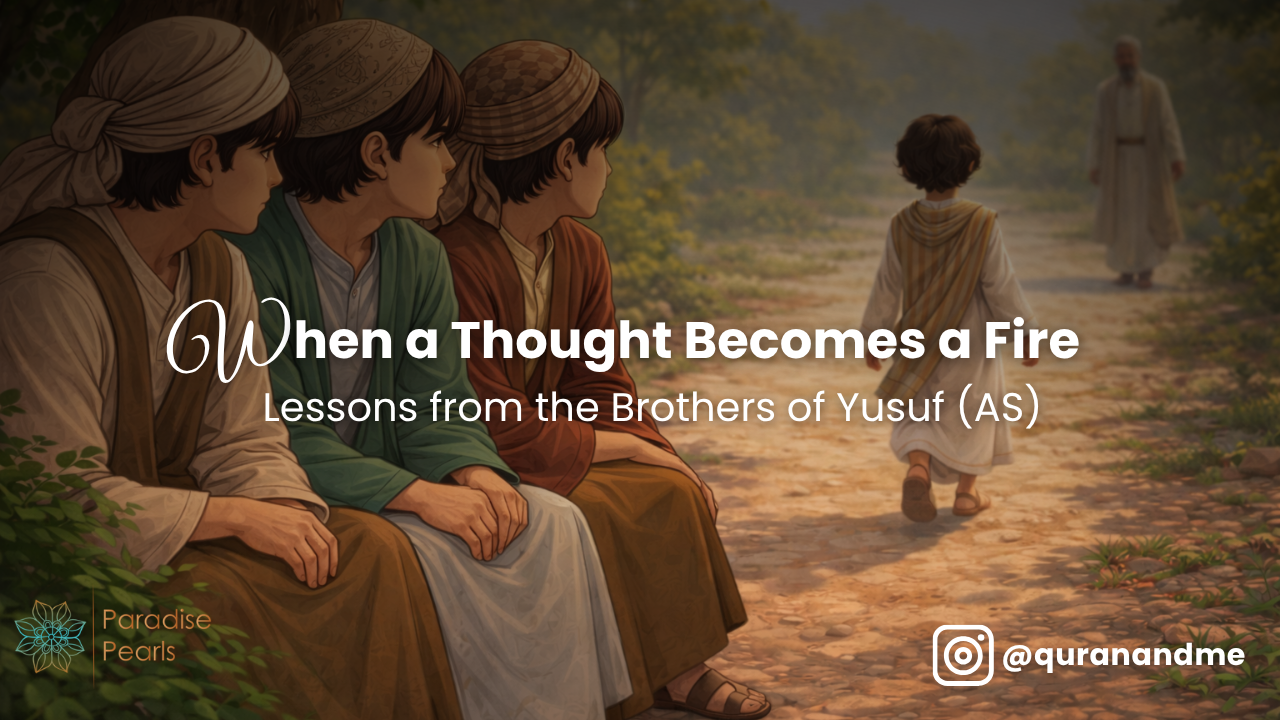
We’ve all seen it: a small disagreement, a borrowed shirt, a passing comment about a “favourite child”, spiralling into days, even weeks, of cold silence.
It starts small. Almost insignificant.
But sometimes, what begins as a fleeting feeling quietly grows into something much heavier.
In the story of Prophet Yusuf (AS), we often focus on the dramatic moments, the well, the blood-stained shirt, the years of separation. But perhaps the most unsettling part of the story isn’t the pit.
It’s the psychological descent that led the brothers there.
The Spark That Ignites a Fire
This is exactly what the great scholar Ibn al-Qayyim warned about:
“Stand firmly against evil thoughts; do not permit them to settle in your mind, for they are sparks that can ignite a great fire if left unattended.”
The brothers of Yusuf (AS) didn’t become villains overnight.
Their actions were the result of a slow, internal process, a quiet unraveling that began long before they stood at the edge of the well.
Allah captures the very beginning of this process:
“Indeed, Yusuf and his brother are more beloved to our father than we are…” (Surah Yusuf 12:8)
A thought. A perception. A feeling.
That’s where it all began.
The 5 Stages of a Falling Heart
Their story reveals a dangerous ladder, one that any of us can climb if we’re not careful.
1. The Passing Thought (Khatir)
“It’s nothing… just a thought.”
It begins with something subtle: “Dad loves him more than us.”
At this stage, it’s fleeting. Uninvited. A spark.
If it’s dismissed, it dies here.
2. The Lingering Idea (Fikrah)
“Maybe it’s true…”
But when the thought isn’t challenged, it lingers.
The brothers began to dwell on their father’s affection. They searched for evidence. Every interaction became proof.
The thought was no longer passing. It had found a place to stay.
3. The Growing Desire (Shahwah)
“Something needs to change.”
Now the feeling deepens.
It’s no longer just about being loved. It becomes about removing what feels like the obstacle.
The focus shifts from “How can we improve?”
To “How can we get rid of him?”
4. The Firm Resolve (Himmah)
“We have to act.”
This is the turning point.
The brothers gathered. They reinforced one another. They convinced themselves their plan was justified.
They even negotiated with their conscience:
“Kill Yusuf… and then you will be righteous people (afterward).” (12:9)
Sin now. Repent later.
At this stage, it no longer feels like a choice. It feels necessary.
5. The Final Action (Fi’l)
“It’s done.”
The thought becomes a deed.
They took Yusuf (AS) to the well. They ignored his cries. They walked away.
What began as a spark became a fire, one that would burn through their family for decades.
What This Looks Like in Our Homes Today
This story isn’t distant. It’s deeply familiar.
You might notice:
- A child constantly comparing themselves to a sibling
- A small joke quietly turning into a belief: “I’m the less loved one”
- Emotional outbursts over seemingly minor issues
- Silence, withdrawal, or subtle resentment
- A deep need for validation, fairness, or attention
- Sometimes, it’s loud.
But often, it’s quiet.
So quiet that we don’t notice it until it grows.
The Lesson: Catch the Spark
Sibling rivalry isn’t just about behaviour. It’s about boundaries within the heart.
That first sting of jealousy. That moment of comparison.
That is the test.
If we recognise it as a passing thought (Khatir), we can stop it. But if we allow it to settle, if we feed it, justify it, revisit it, we risk climbing the same ladder.
Because by the time it reaches action, it rarely feels wrong.
It feels deserved.
The story of Yusuf (AS) is not just a story.
It’s a mirror.
It asks us:
- What thoughts am I allowing to settle in my mind today?
- Is there any jealousy, resentment, or comparison I’ve left unchallenged?
And Yet… The Story Doesn’t End There
The well was not the end of Yusuf’s (AS) story.
It was the beginning of his elevation.
And that’s where the deeper lessons unfold, not just in family dynamics, but in the internal battles of the soul.
Continue the Journey
We’re excited to introduce Part 2 of the Teens Journey through Surah Yusuf.
While Part 1 explored the external tests of family, jealousy, and betrayal, Part 2 turns inward, toward the struggles we face within ourselves.
In this next module, we explore:
- The Power of Sabr, understanding the difference between giving up and beautiful patience
- The Palace & The Trap, navigating temptation and peer pressure with strength and clarity
- Spiritual Integrity, staying true to your values when no one is watching
What if the very thing that feels like a setback in your life
is actually your path forward, just as it was for Yusuf (AS)?
Join our community
Join our community and get golden life advice emailed to you every two weeks.
We hate SPAM. We will never sell your information, for any reason.
